Can a Hot Car Kill Bed Bugs? We Tested It
Test Results at a Glance
The short version, for anyone who doesn't need all twelve minutes.
- Dashboard and seats: plenty hot — 140–150°F on the dash, 116–136°F on the seats. A bed bug sitting out in the open here would die.
- Inside bags, boxes, and under the seats: too cool — only 94–114°F. The insulation keeps the middle survivable, and that's exactly where bed bugs hide.
- The verdict: a hot car can spot-kill exposed bugs, but it can't push lethal heat into the packed, insulated spots where an infestation actually lives. Heat kills bed bugs — a parked car just can't get it everywhere it needs to go.
Need something for right now? A research-backed contact spray like EcoRaider won't clear an infestation on its own, but it can knock down the bugs you can see while you line up a treatment that finishes the job.
This is one of those ideas that sounds so logical. It's a Tulsa summer, your car has been sitting in the parking lot at Woodland Hills Mall for three hours, and when you open the door it feels like walking into a brick oven. Surely that kind of heat could kill bed bugs, right?
The internet is full of people suggesting this approach. Put your infested items in black garbage bags, toss them in your car on a hot day, let nature do the work. Free bed bug treatment, courtesy of the Oklahoma sun.
We see this question come up constantly, and we realized we'd never actually tested it ourselves. So we decided to find out. And look, we're bed bug specialists, not scientists. But we figured if we could remember enough from high school biology to set up a halfway decent experiment, we could at least get a real answer.
What We Already Know
We deal with heat and bed bugs every day, so the thermal death points aren't new to us. Adult bed bugs need sustained exposure to about 119°F for immediate death. Eggs are tougher and need around 131°F, or sustained exposure to 118°F for over an hour. A study from the University of Minnesota backs this up.1
We also know from experience that the temperature of the air isn't the same as the temperature the bugs actually experience.1 If you've got items sitting in a hot room, the stuff inside those items takes way longer to heat up than the air around them. This is why we crank rooms up and hold them there for hours during treatments.
So we weren't testing whether heat kills bed bugs. We know it does. The question was whether a car sitting in the Oklahoma summer sun could actually get hot enough, in enough places, for long enough. Not just "get hot" but "get hot in the way that matters."
Our Hypothesis (That's the Prediction Part, Right?)
We figured the car would definitely get hot enough in some spots, like the dashboard. But we were skeptical about whether bags or boxes inside the car would heat all the way through. Our prediction was that exposed surfaces would work, but anything with insulation or mass would fail.
What We Did
We ran this test in Broken Arrow during the last week of July 2025. Five days, all of them clear and hot. There was actually an excessive heat warning that week. Highs ranged from 93°F to 100°F. Perfect conditions.
The car: My 2015 Acura TLX. Dark interior, leather seats (or maybe that fake leather stuff, I'm honestly not sure, but either way they get hot to the touch), and factory tinted windows. I parked it in an open lot with zero shade from 10 AM to 5 PM each day. Windows up, no sunshade, just baking.
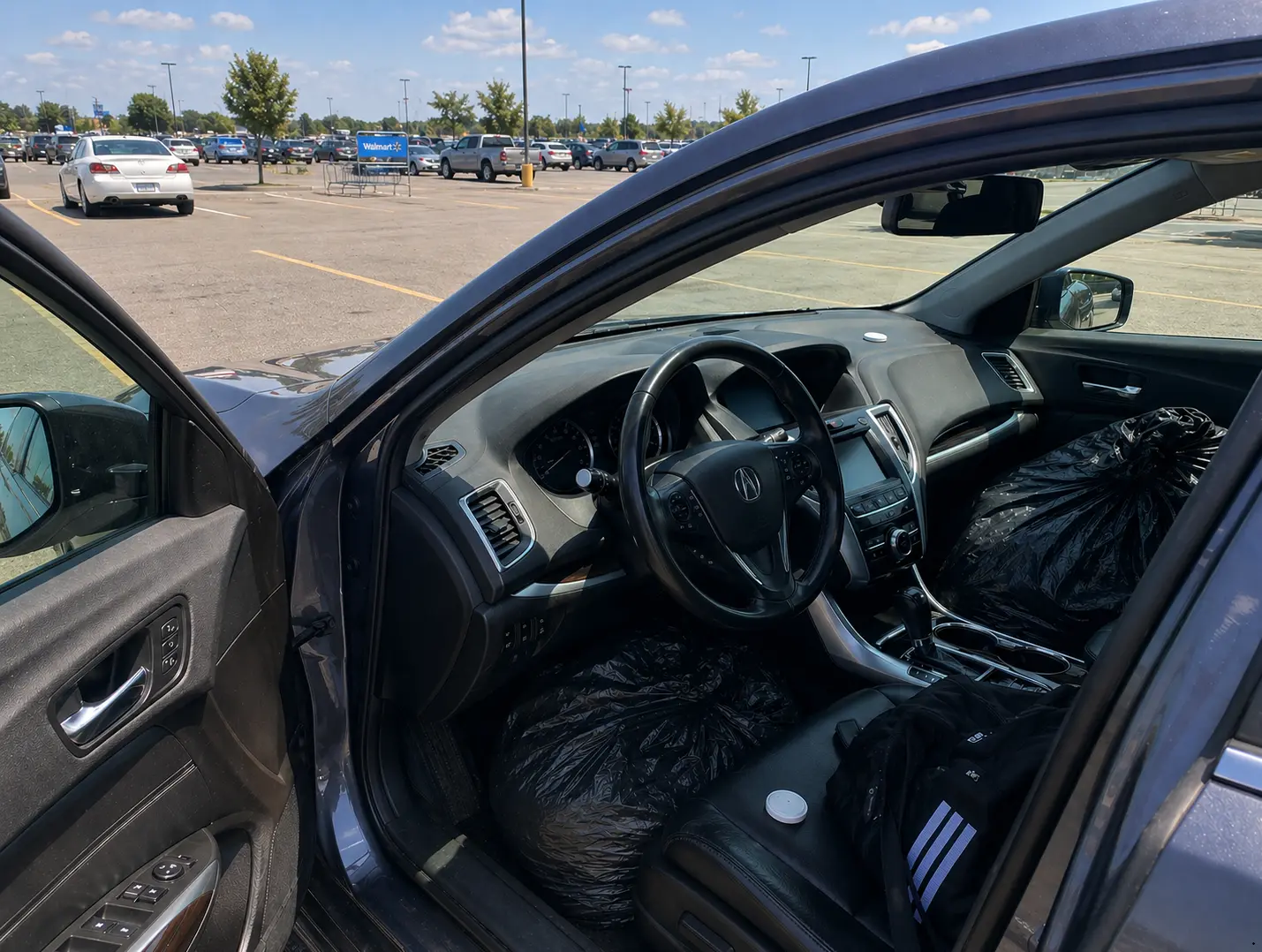
The temperature tracking: This is where we had an advantage. We use Bluetooth temperature and humidity beacons for our actual heat treatments. They're how we verify that every part of a room is hitting lethal temps during a job. So we already had a bunch of them sitting around. We placed six beacons throughout the car to log temperature and humidity every few minutes:
- Dashboard, right in the sun
- Driver seat surface
- Back seat surface
- Floor under the driver seat
- Inside a duffel bag full of clothes on the back seat
- Inside a closed cardboard box in the trunk
The idea was to test the range of conditions. Best case scenario (dashboard in direct sun) all the way down to worst case (inside a container, inside the trunk).
We didn't use live bed bugs for this. We didn't need to. We already know exactly what temperatures kill them and how long it takes. The real question was just whether a car could hit those numbers. If the temps are there, the bugs are dead. If not, they survive. Simple as that.
If you're going to try it anyway
Don't guess the temperature — measure it
This whole experiment only meant something because we logged the actual temps. You don't need professional beacons to do the same. A cheap wireless thermometer tucked inside the bag or box tells you whether your DIY heat is really reaching the 120°F-plus that kills bed bugs — or just feeling hot on the surface while the middle stays comfortably survivable.
See the thermometer we used →The Results (Data First, Then What It Means)
Okay, here's what we actually recorded. We're including the numbers because that's what makes this a real test instead of just "trust us, it was hot."
Dashboard: This was the hottest spot, obviously. On the hottest days when outside temps hit 100°F, the dashboard broke 150°F by early afternoon and stayed above 140°F for about four to five hours. On the cooler days (93°F outside), it peaked around 140°F. The tinted windows didn't seem to matter much up front where the windshield lets the sun pour in.
Driver seat surface: The leather (or whatever it is) seats got hot. Like, burn your legs if you're wearing shorts hot. The beacon recorded temps between 123°F and 136°F during peak hours. Definitely in the kill zone for adult bed bugs if you're looking at exposed surfaces.
Back seat surface: Slightly cooler than the front, ranging from 116°F to 128°F. The tint on the rear windows probably knocked this down a bit. Still hot enough to kill adults on a good day, but getting into borderline territory on the cooler days.
Floor under the driver seat: This is where things got interesting. The floor maxed out at 108°F to 114°F across our test days. That's below the threshold for quick kills. Bed bugs can die at 113°F, but they need to stay at that temperature for 90 plus minutes.2 Some days we hit that window, some days we didn't.
Inside the duffel bag: The seat surface under the bag hit 125°F. But inside the bag, buried in the clothes? The beacon only recorded 104°F to 112°F. The clothes acted as insulation and kept the center of the bag way cooler than the air around it. This matched up almost exactly with a test that Bed Bug Supply ran a few years back, where they put towels in black garbage bags in 90°F sun and couldn't get the internal temps above 110°F.3
Inside the box in the trunk: The trunk air got warm, but nothing crazy. The beacon inside the cardboard box topped out at 94°F to 102°F depending on the day. Completely survivable for bed bugs. Not even close to lethal.
Humidity: One thing we noticed from the beacon data: humidity inside the bags and boxes actually went up as temps rose. Moisture coming off the contents, we're guessing. The research says humidity doesn't directly affect bed bug heat tolerance much,1 but it was interesting to see.
What Would Have Died (And What Wouldn't)
Since we know the thermal death points, we can map our temperature data onto what would have actually happened to bed bugs in each location.
Dashboard: Dead. 140-150°F for hours is instant kill territory. Anything sitting directly on the dashboard wouldn't stand a chance.
Seat surfaces: Probably dead, eventually. The temps were in the right range on most days, but just barely. If bugs were sitting right on the leather with nowhere to hide, they'd likely die after a few hours of sustained exposure. But "probably" and "eventually" aren't words you want when dealing with bed bugs.
Under the seats: Survival likely. The floor temps hovered right around the edge of what's needed. Some days would have been marginal kills, other days the bugs would have been uncomfortable but fine. If there were any cooler pockets, like in the carpet fibers or tucked into a seam, survival would be even more likely.
Inside the duffel bag: Survivors for sure. The temps inside the bag never consistently hit the 113°F minimum, let alone the 118°F+ needed for reliable kills. Five days of this treatment and you'd still have live bugs in your clothes.
Inside the trunk box: Definitely survival. 94°F to 102°F isn't even stressful for bed bugs. They'd be perfectly happy in there.
Why Tinted Windows Might Actually Hurt
One thing I wondered about going in: would the factory tint help or hurt? Turns out, it's a bit of both.
The tint definitely knocked down the temps in the back seat compared to the front. The dashboard and front seats got the full greenhouse effect through the clear windshield, while the rear was somewhat shielded.
On the other hand, the black interior probably helped absorb and retain heat overall. A car with light tan leather might run even cooler. I didn't test that, but it's something to consider.
The Verdict: It Works in Some Spots, Fails in Others
Our hypothesis was pretty much right. The car gets hot enough to kill bed bugs on exposed surfaces like the dashboard and seats. But the temperature variation from one spot to another is massive.
On a 100°F day, my car had more than a 50 degree difference between the hottest spot (150°F on the dashboard) and the coolest spot (94°F inside the trunk box). That's the difference between "dead instantly" and "perfectly comfortable."
The biggest problem is insulation. Anything with mass or layers, like a bag of clothes, a box of books, a suitcase, doesn't heat evenly. The outside gets hot while the inside stays cool enough for bugs to survive. This matches what the research says about professional heat treatments needing hours at high temperatures to actually penetrate into items.
So Does It Work or Not?
Honestly? Sometimes. But you can't count on it.
It might work if:
- Items are thin and loose, spread flat on the dashboard or seats
- You're doing this during a heat wave with temps over 100°F
- You leave items for multiple days in a row
- You're only worried about adult bugs, not eggs
It probably won't work if:
- Items are in bags, boxes, suitcases, or containers
- Items have any real thickness to them
- You need to kill eggs (which need higher temps than adults)
- Your car has heavy tint or any shade
- Items are on the floor or in the trunk
The EPA actually says the same thing. Their guidance on DIY heat treatment notes that the hot car method "might work to kill bed bugs in luggage or small items, if the contents become hot enough."4 They emphasize that "success depends on your climate and other factors."5
"Might work" and "depends on factors" isn't really what you want to hear when you're trying to solve a bed bug problem.
What Actually Works Better
If you need to heat treat specific items and want to be sure, a regular household dryer is way more reliable than a car. Thirty minutes on high heat kills all life stages. The tumbling keeps everything moving so heat reaches all the surfaces, and dryers maintain consistent temperatures the whole time.
For stuff that can't go in a dryer, there are commercial bed bug heaters designed for exactly this. They're basically insulated bags with heating elements that maintain a verified temperature throughout.
Once we wrapped the test, we still gave everything a quick pass with EcoRaider before bringing it back inside — old habit, and cheap insurance. It's the one natural spray that actually held up in independent lab and apartment testing, killing bed bugs and their eggs on contact about as well as the professional stuff. A spray won't clear an infestation on its own (we tested the whole natural-spray market to explain why), but for the bugs you can actually see, it's what we keep on hand.
And for an actual infestation in your home, professional heat treatment is the only way to guarantee results. The difference is that professional equipment actively circulates hot air, monitors temperatures in multiple locations (with those same Bluetooth beacons we used for this test), and maintains lethal heat for hours until every hiding spot is confirmed hot enough. A car just sits there and hopes the sun does the work.
The Takeaway
We went into this thinking the hot car method was probably unreliable, and that's exactly what we found. It works great for killing bugs on your dashboard. It does not work great for killing bugs inside your stuff, which is where they actually are.
If you're in a pinch and you want to treat a few loose items by laying them flat on your seats during a brutal July afternoon, go for it. But if you're dealing with an actual infestation and you're hoping your car can solve the problem, you're going to end up frustrated.
Heat kills bed bugs. But only if you can get the heat to where the bugs are hiding, and keep it there long enough to finish the job. A hot car can't guarantee either of those things.
References
- Kells, S. A., & Goblirsch, M. J. (2011). Temperature and time requirements for controlling bed bugs (Cimex lectularius) under commercial heat treatment conditions. Insects, 2(3), 412-422.
- Pereira, R. M., Koehler, P. G., Pfiester, M., & Walker, W. (2009). Lethal effects of heat and use of localized heat treatment for control of bed bug infestations. Journal of Economic Entomology, 102(3), 1182-1188.
- Bed Bug Supply. (2010). Trash bags left in the sun not an effective treatment for bed bugs. Retrieved from bedbugsupply.com
- U.S. Environmental Protection Agency. Top ten tips to prevent or control bed bugs. Retrieved from epa.gov/bedbugs/top-ten-tips-prevent-or-control-bed-bugs
- U.S. Environmental Protection Agency. Do-it-yourself bed bug control. Retrieved from epa.gov/bedbugs/do-it-yourself-bed-bug-control
A couple of links in this article go to products on Amazon. As an Amazon Associate, Flare earns from qualifying purchases — at no extra cost to you. We only point to gear we'd actually use.