Understanding the Bed Bug Lifecycle
A bed bug starts its life as a pearl white speck no bigger than a poppy seed. Its mother glues it to the seam of a mattress or to a tiny crack behind a baseboard, and a few weeks later, after five blood meals, that same insect is a fully grown adult, ready to start laying eggs of its own. Inside a typical Tulsa home, where the temperature stays comfortable year round, the whole process can wrap up in about five weeks.
That speed is the reason bed bug problems explode the way they do. It's also the reason most sprays fail to clear them, why infestations can survive months of an empty house, and why properly applied heat treatment ends the problem in a single day. Understanding the lifecycle isn't just a science lesson. It's the difference between solving a bed bug problem and chasing it for a year.
Here's a walkthrough of every stage in the life of Cimex lectularius, the common bed bug. We'll cover the biology, the timings, the survival strategies, and what all of it means for treatment. Where the article relies on published research, you'll see a small superscript number that links to the references section at the bottom of the page.
Quick Facts
- Stages: 1 egg, 5 nymph instars, and the adult, for 7 total life stages
- Egg to adult time: about 21 days at 80 °F, around 37 days at 73 °F1
- Lifetime egg output: 200 to 500 eggs per female2
- Adult lifespan: 4 to 6 months at room temperature, over a year in cool conditions
- Starvation tolerance: Adults can survive 70 days or more without feeding at room temperature, and far longer when cold3
- Thermal death point: All stages, including eggs, die at a sustained 118 °F within about 71 minutes, and nearly instantly above 122 °F4
Know Your Enemy: A Quick Taxonomy
The bed bug we deal with in North American homes is Cimex lectularius. Carl Linnaeus formally described the species in 1758, in the same foundational work of zoology that named most of the modern animal kingdom. It belongs to the family Cimicidae, which contains about 75 species in total. They all share one defining trait: every member of the family lives exclusively on vertebrate blood and cannot complete its lifecycle without it.2
The family sits inside the larger order Hemiptera, also known as the "true bugs." That's the group of insects with mouthparts built for piercing and drawing fluids. It's a useful distinction, because it means bed bugs are not beetles, fleas, or ticks. Their mouth is a slender, jointed proboscis called the stylet fascicle. It folds neatly under the body between meals, then unfolds during feeding to pierce skin and find a capillary. The most authoritative reference on the family Cimicidae is Robert Usinger's 1966 monograph, which is still the starting point for serious entomologists working on bed bugs today.5
There is a second species too. Cimex hemipterus, called the tropical bed bug, looks nearly identical to the untrained eye but only lives in warmer climates. In the United States, infestations are almost always C. lectularius, though confirmed C. hemipterus populations have been reported in Florida and a few other southern states.6
The earliest hosts of Cimicidae appear to have been bats, not humans. Modern bed bugs are thought to have switched over to people in the caves of the Mediterranean during the Upper Paleolithic, around a quarter of a million years ago. That long shared history is part of why they're so good at making themselves at home in our houses. Human shelter is warm, predictable, and packed with people who go to sleep in the same place every night.
Stage 1: The Egg
A bed bug egg is small enough that most people miss it on a casual inspection. It's about 1 millimeter long, elongated and slightly curved like a tiny grain of rice, with an off white pearl color and a faint sheen on the surface. At the front end is a small hinged cap called the operculum, which the developing nymph eventually pushes open to hatch out.
What makes the egg a problem for treatment isn't its appearance. It's how the egg is attached. When the female lays an egg, she coats it in a transparent cement that cures within minutes and bonds it to almost any surface: fabric weave, raw wood, painted drywall, the inside of a box spring frame, the stitching of a luggage seam. Once cured, that adhesive is remarkably durable. Vacuuming alone usually does not dislodge eggs from textured surfaces, which is why a thorough cleaning after treatment always includes brushing along seams rather than just suction.
A healthy female lays anywhere from 1 to 12 eggs per day when she has steady access to blood, and 200 to 500 eggs over her lifetime.2 Egg production is tightly coupled to blood meals. A starved female stops laying within a few days and starts again within hours of feeding. This is one of the reasons an infestation can seem to "pause" when the host is away for a long stretch. The population isn't dying. Reproduction has just gone dormant until the next meal.
Incubation depends almost entirely on temperature. At 80 °F, eggs hatch in about 6 to 7 days. At 73 °F, it takes 8 to 10 days. Below about 55 °F, embryonic development effectively stops, though it doesn't immediately kill the embryo.1 Hatch rates under good conditions are above 95 percent.
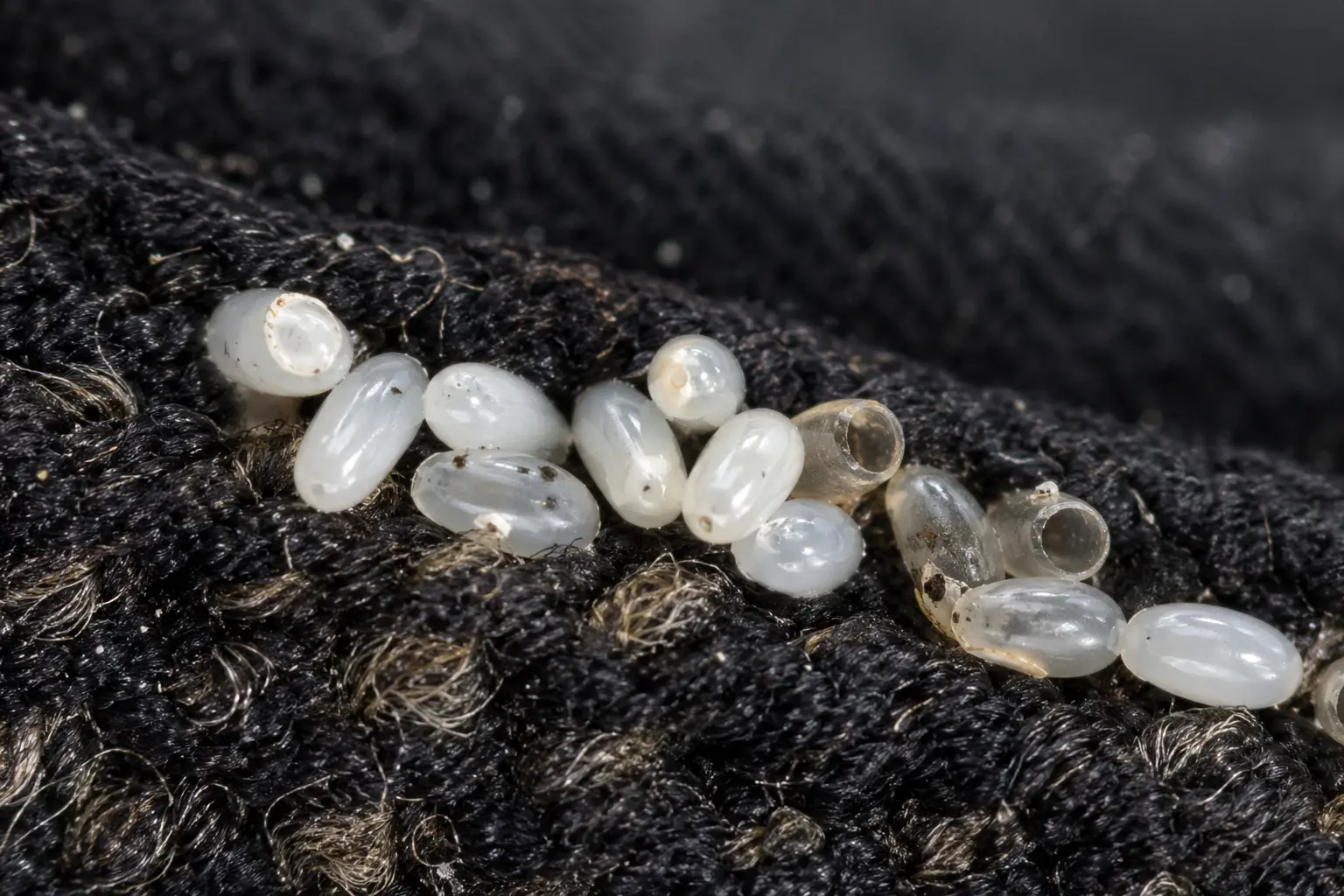
The egg shell itself, called the chorion, is worth a quick note because it has direct treatment implications. The chorion is built from multiple layers of chitin and protein, lined inside by a waxy embryonic membrane that most contact insecticides cannot penetrate. This is why so many sprays that successfully kill the adult bed bugs in a home leave the eggs completely untouched. Seven to ten days after the spray, a new generation hatches into what looked like a clean home, and the cycle starts over. We cover this failure mode in detail in our piece on eco sprays tested.
Stages 2 to 6: The Five Nymph Instars
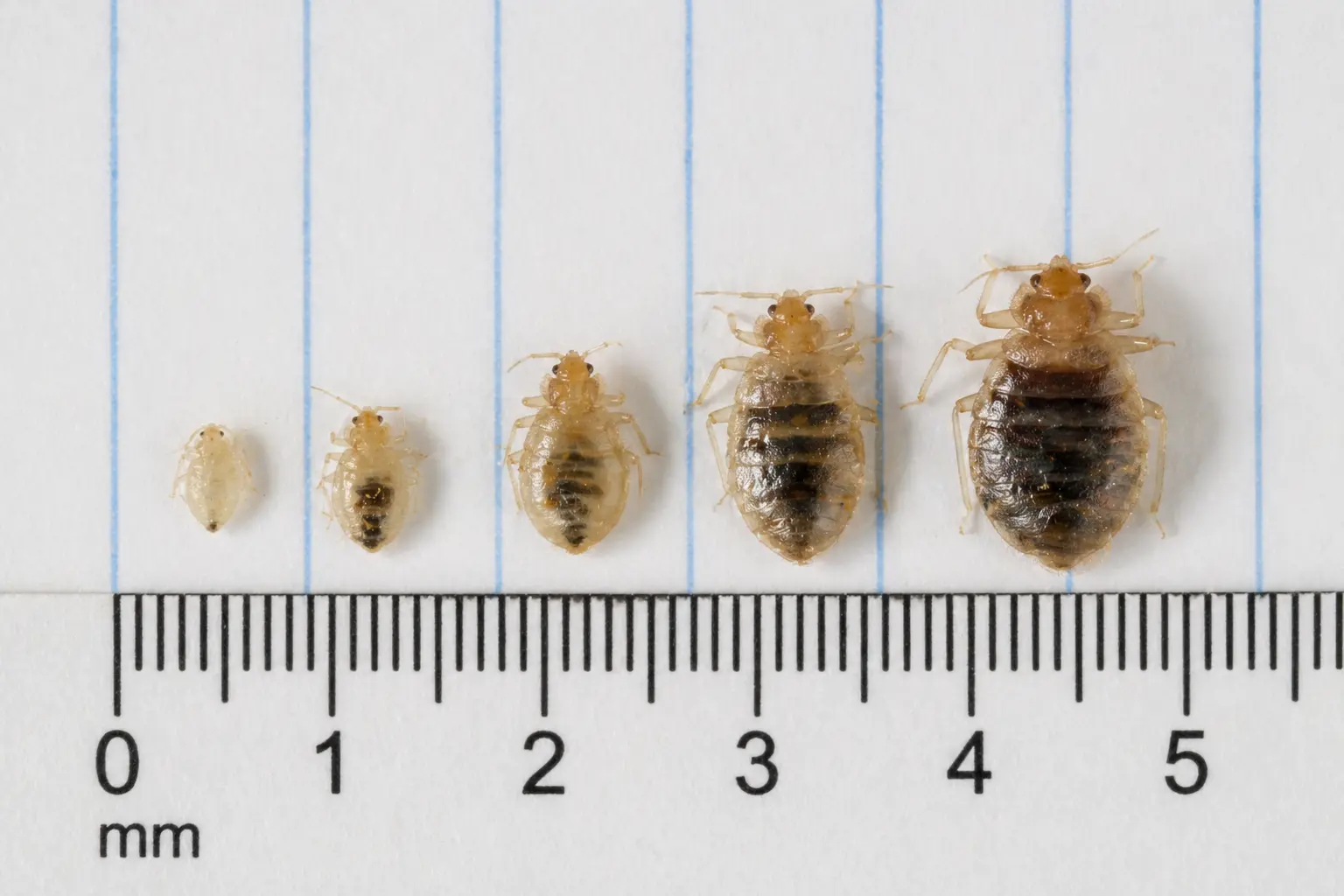
Between hatching and adulthood, a bed bug passes through five juvenile stages called instars. Each instar is basically a smaller, paler version of the adult, but with one strict biological rule: every instar has to take a full blood meal before it can molt into the next stage. No blood, no molt. No molt, no progression. That's the most important fact about the nymph phase. Bed bug development is tied directly to the presence of a host. No host, no growth.
A nymph comes out of its old stage with a soft, pale, slightly larger body. Over the next several hours, that new exoskeleton hardens, a process called sclerotization. The nymph then goes looking for a blood meal, takes 3 to 12 minutes to feed to capacity, retreats to a hiding spot to digest, and a few days later, if conditions are right, molts to the next instar. Each molt leaves behind a translucent cast skin called an exuvium. These cast skins are one of the most useful diagnostic clues you can find. If you spot tiny, hollow, ghost pale shells along a mattress seam, you're not looking at old dead bed bugs. You're looking at evidence that a population is actively feeding and growing.
A freshly hatched 1st instar nymph is so small and so pale that it's nearly transparent against light fabric. You only really see it after its first feed, when it shows up as a tiny red comma, the visible blood inside its tiny body. The first three instars are the stages most likely to be missed during a self inspection, and they're disproportionately responsible for spreading an infestation to nearby rooms or units. Their small size lets them squeeze through gaps in baseboards, electrical outlets, and shared wall voids.7
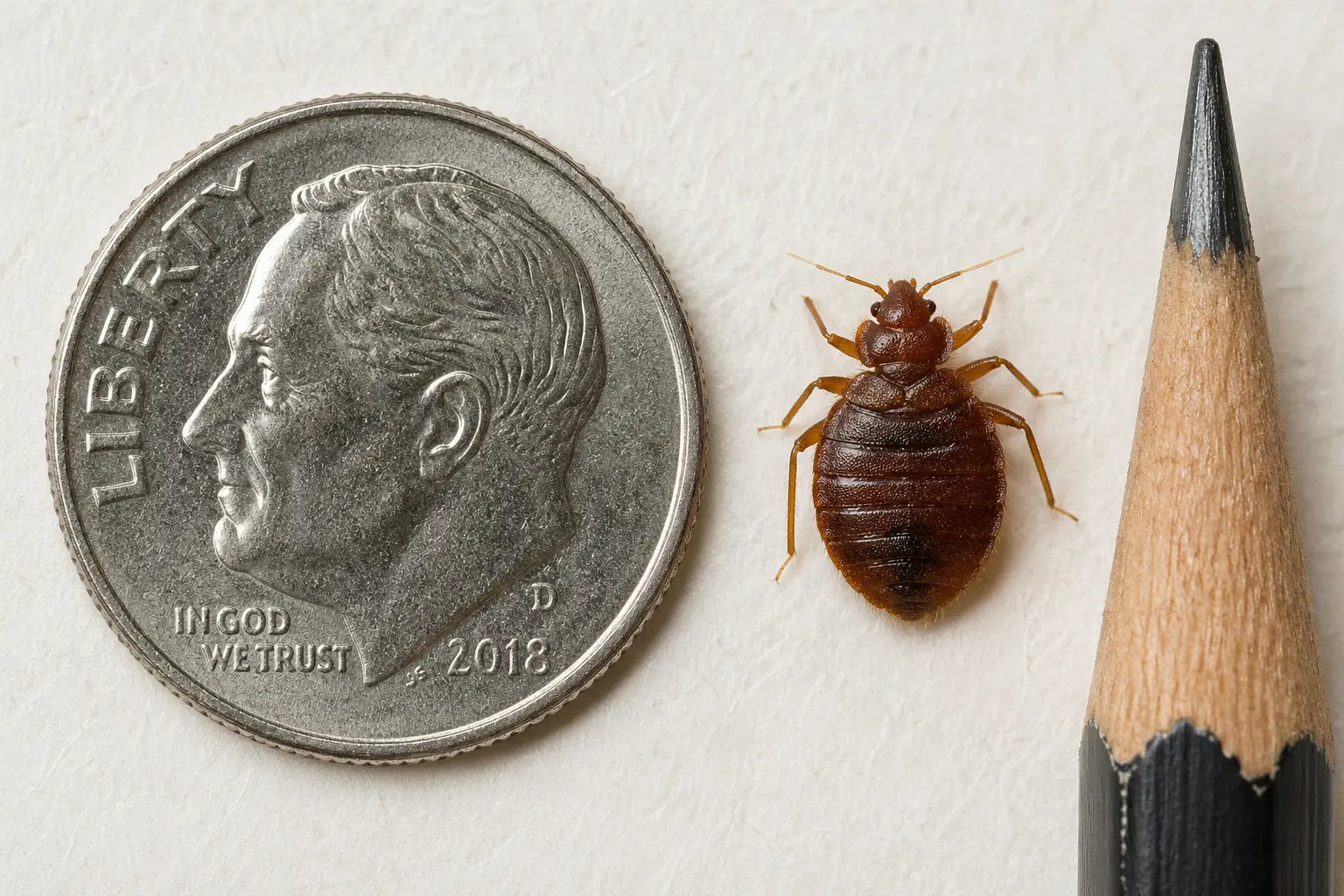
By the 4th and 5th instars, the body has darkened toward the adult mahogany color, and a fully fed insect is roughly the size of an apple seed. The 5th instar is the longest of the juvenile stages, and the molt out of it produces a sexually mature adult.
Total time from hatching to adulthood, with steady access to a host and warm room temperatures, runs about 21 to 28 days. With irregular feeding, partial host access, or cooler conditions, the same span can stretch out to 60 days or longer.1
Stage 7: The Adult Bed Bug
The adult Cimex lectularius is the stage most people picture when they hear "bed bug." It's flat and broadly oval when unfed, a shape evolved specifically for hiding in narrow cracks and crevices. After a blood meal, the abdomen expands dramatically into a darker, elongated, almost cigar shape, often called engorged. The change is so pronounced that an unfed bed bug and a recently fed one can look like two different species to an untrained observer.
Adults have vestigial wing pads but no working wings. Bed bugs do not fly. They do not jump. They are exclusively crawlers, and reasonably fast ones, moving at speeds comparable to an ant on a smooth surface. This is why infestations spread along physical pathways: shared walls, electrical conduits, plumbing chases, and most of all items that humans carry around. Luggage, secondhand furniture, rideshare seats, laundry hampers, and so on.
You can tell the sexes apart under magnification by looking at the back of the abdomen. Females have a smoothly rounded posterior. Males have a more pointed end, with a visible curved structure called the paramere. That paramere is the organ used in their unusual mode of reproduction, which we'll get to in a moment.
Adult lifespan varies enormously based on conditions. Under warm, fed, undisturbed circumstances, an adult typically lives 4 to 6 months. Under cool conditions with intermittent feeding, like a vacant apartment with the heat turned off, adults have been documented surviving well over a year, with some laboratory observations passing 18 months.2 That longevity, combined with extreme starvation tolerance, is the reason "just leave the house empty for a few months" is not a viable bed bug strategy.
Reproduction: Traumatic Insemination
Bed bug reproduction is one of the strangest and most studied mating systems in the animal kingdom. It also has direct relevance to how infestations spread.
In nearly every other insect, mating involves the male transferring sperm into the female's reproductive tract. Bed bugs do not. Instead, the male uses his sharp, curved paramere to literally pierce through the female's abdominal wall. The process is called traumatic insemination, or extragenital insemination.8 Sperm is deposited directly into the female's body cavity, called the haemocoel, where it then travels through the haemolymph (the insect's version of blood) until it reaches the ovaries.
Females have evolved a defensive structure called the spermalege, a specialized organ on the right side of the abdomen that absorbs the wound and concentrates immune defense at the site of insemination. The spermalege reduces the cost of mating but does not eliminate it. Each insemination event is energetically expensive, raises the risk of infection, and measurably shortens the female's lifespan. As a result, females are evolutionarily incentivized to mate just once, store the sperm, and avoid any further encounters with males.8
This reproductive system has an unsettling consequence for infestation control: a single mated female is enough to start a new colony. If she rides home in a piece of luggage or hides inside a returned piece of furniture, she carries with her enough stored sperm to produce hundreds of fertilized eggs over the following weeks. She doesn't need any further contact with a male. That's one of the reasons bed bug infestations can show up in brand new apartment buildings that have never had bed bugs before, and why bagging and isolating any suspect items matters so much.
How Long Does the Whole Cycle Take?
Bed bug development is governed almost entirely by temperature, with smaller effects from feeding frequency and humidity. The most cited modern dataset comes from a 2011 life table study by Polanco, Brewster, and Miller, who tracked egg to adult development across a range of temperatures.1
The headline numbers:
- At 80 °F: about 21 days from egg to reproductive adult
- At 73 °F: about 37 days
- At 65 °F: 70 days or more
- Below 55 °F: development effectively stops, though it doesn't kill the bugs immediately
Once you understand those numbers, the population dynamics fall into place. A founding pair brought into a warm, occupied home in May lays eggs within days. Those eggs hatch in a week. The new nymphs reach adulthood and start reproducing in three to four weeks. Their offspring follow the same schedule. Within 100 days, what started as 10 mated females can grow to over 1,000 individuals, with thousands of additional eggs still developing. That's not just a theoretical maximum. Pest management studies have observed populations following exactly this trajectory in real homes.7
That exponential growth is the reason "wait and see" is the most expensive strategy a homeowner can pick. Every two or three weeks of delay corresponds to roughly a doubling of the population in your home.
Survival: Why Bed Bugs Are So Hard to Outlast
If you've ever wondered why bed bugs are notorious for surviving in vacant apartments, sealed luggage, and storage units, the answer is a combination of three remarkable physiological adaptations: long term starvation tolerance, freeze tolerance, and a flexible metabolism.
Starvation Tolerance
At normal room temperature, adult bed bugs can survive 70 to 150 days without feeding, depending on how well fed they were beforehand and the humidity in the space.2 At cooler temperatures around 50 °F, starved adults have been recorded surviving for over 400 days.3 The earlier instars are less tolerant. They typically last several weeks rather than several months, but that's still much longer than most homeowners would expect.
The mechanism is straightforward. When food is unavailable, bed bugs lower their metabolic rate dramatically and enter a state similar to insect quiescence. They don't move, they don't seek hosts, and they survive on stored fat and minimal water. That's why an infestation can appear to vanish during a long absence and then reappear within hours of the host's return.
Cold Tolerance
Bed bugs are surprisingly tolerant of cold. A 2013 study by Olson and colleagues showed that to kill all life stages, you need to expose them to 3 °F for at least 80 hours straight.3 Eggs are actually more cold tolerant than adults, because they contain higher levels of cryoprotective compounds like glycerol, which lower the freezing point of internal fluids. A brief cold snap, even a Tulsa winter night below freezing, is not even close to enough to clear an infested item left in an unheated garage. A full continuous cold soak, with a thermometer placed inside the item to verify the temperature actually held, is what it takes.
Heat Tolerance, and Where It Breaks
Heat is the opposite story. Bed bugs evolved as cave dwelling companions to mammals, and they have no adaptive history of exposure to sustained temperatures above about 104 °F. They can survive brief temperature spikes, like a hot shower or a sun warmed windowsill, but their cellular machinery, especially the ribosomes and the membrane bound enzymes, denatures rapidly at any sustained temperature above 113 °F.9
The two most cited mortality datasets are:
- Pereira and colleagues (2009): 100 percent adult mortality at a sustained 113 °F for about 95 minutes.10
- Kells and Goblirsch (2011): 100 percent mortality across all life stages, including eggs, at a sustained 118 °F for about 71 minutes. The most thermally resistant stage in their study was the egg.4
Above 122 °F, mortality across all stages becomes essentially instant on contact. That's the exact thermal range professional bed bug heat treatment targets.
Why Sprays Fail Against the Lifecycle
With all of that as background, we can now explain something that frustrates an enormous number of homeowners: why repeated DIY spray applications, including some professional grade products, so often fail to clear an infestation. There are two main reasons, and both come straight out of the lifecycle.
Most contact insecticides do not penetrate eggs. The chitin chorion combined with the waxy serosal membrane lining the embryo is highly impermeable to chemicals. Adulticide products like pyrethrins, pyrethroids, and many neonicotinoids kill mobile bed bugs effectively but leave the eggs largely unaffected. Seven to ten days after a successful adult kill, those eggs hatch, and the homeowner sees what looks like a brand new infestation.
Pyrethroid resistance is now widespread. The pyrethroid class of insecticide was the workhorse of bed bug control for decades, but populations across the United States have evolved high levels of resistance through several genetic mechanisms. These include knockdown resistance mutations in the sodium channels of nerve cells, and increased activity of the enzymes that break down pesticides inside the bug's body. Romero and Anderson (2016) documented similarly high resistance to neonicotinoids, the next generation chemistry that was supposed to replace pyrethroids.11 In many populations today, "knockdown" just means a bug that's temporarily stunned. The bug wakes up a few hours later and resumes feeding.
For a deeper comparison of common DIY spray products and what the lab data actually shows, see our companion piece on eco sprays tested.
Why Heat Treatment Beats Every Stage
Heat treatment, which means raising an entire space to lethal temperatures in a controlled way and holding it there for a calibrated amount of time, defeats the lifecycle in a way no chemical can.
It kills every stage at the same time. Eggs, all five nymph instars, and adults all share the same thermal vulnerability. There's no resistant stage, no protected stage, no stage that "waits it out" the way eggs ride out a chemical spray.
It penetrates everywhere bugs hide. Heated air diffuses into wall voids, the inside of mattresses, the inside of electronics, the back of picture frames, the inside of luggage, and the gap between baseboards and drywall. There's no harbor that's out of range, as long as the treatment temperature holds long enough for the cold spots in the room to come up to thermal equilibrium.
It does not select for resistance. Heat denatures proteins through bulk biophysical action. There's no genetic mutation that makes a bed bug egg's chorion stable at 122 °F. Unlike chemical resistance, which can evolve in a population over generations, thermal resistance is essentially impossible.
It leaves no residue. Once the treatment is finished and temperatures come back down to normal, the home is immediately livable again. There's no waiting period for off gassing, no chemical residue on bedding, and no exposure concerns for pets, infants, or anyone with asthma.
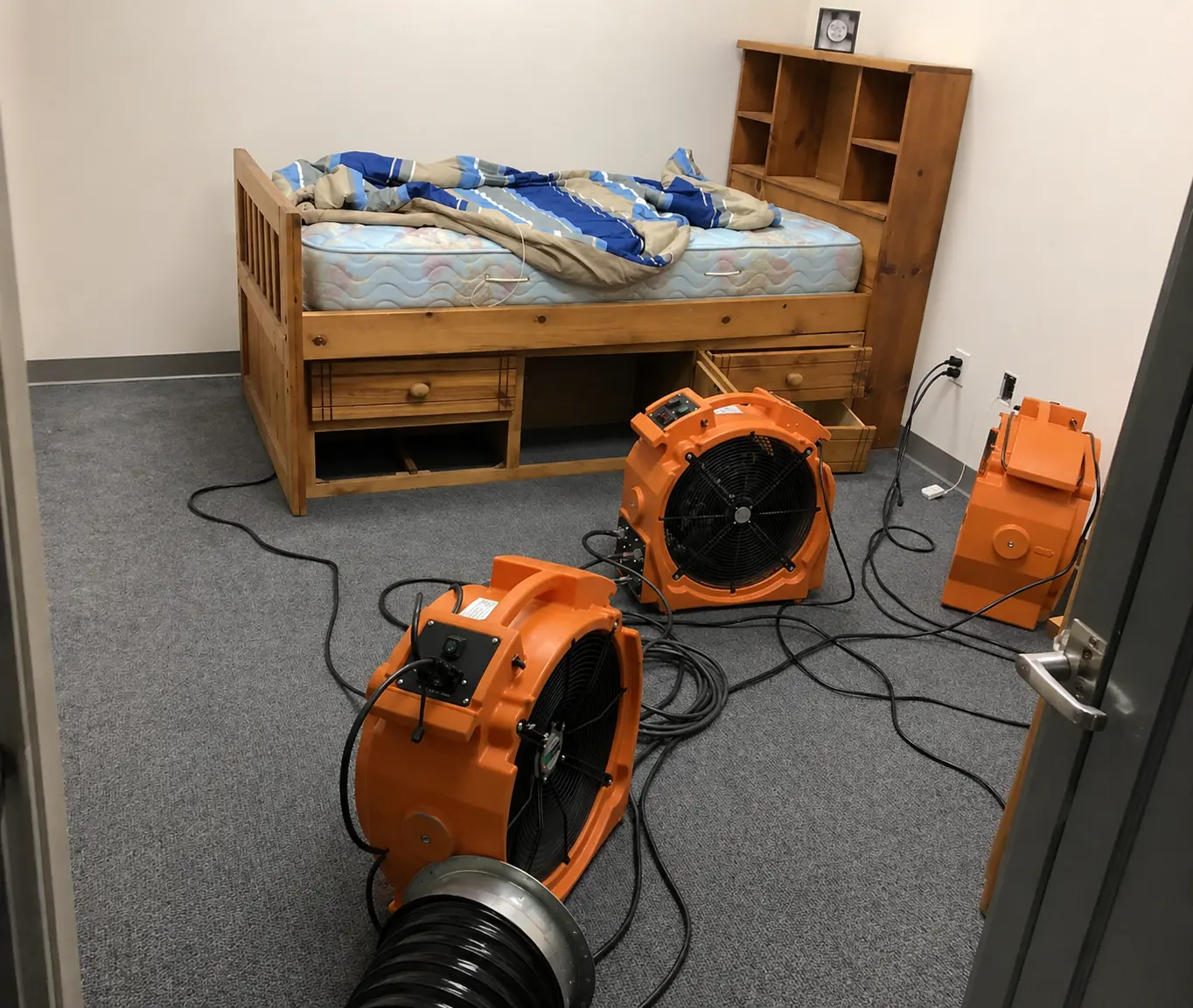
The thermal protocol Flare uses is calibrated against the published data above. We hold temperatures in the 120 to 140 °F range, sustained at the coldest point of the treated zone for several hours, with continuous monitoring through wireless temperature sensors placed at key harborage points around the space. The methodology, the equipment, and the reasoning behind the way we do it are covered in our pieces on comparing bed bug control methods and heat retention in clothes and mattresses.
What This Means for Tulsa Homeowners
Tulsa's climate is, ironically, almost perfectly engineered for bed bug success. Hot summers don't help, because your air conditioning keeps the indoor temperature around 72 °F regardless of what's happening outside, and that's squarely in the optimal reproduction zone for Cimex lectularius. Cold winters don't help either, because your central heat keeps interior walls and floors well above the 55 °F threshold where bed bug development would otherwise pause. The same climate control that makes a Tulsa home comfortable for you makes it ideal year round breeding habitat for a bed bug population.
Two practical implications follow from that.
Seasonal "natural" mortality is essentially zero indoors. Don't expect a January cold snap or an August heat wave to thin out an indoor population. Climate controlled buildings flatten out exactly the kind of temperature swings that would otherwise stress the insects.
Time is not on your side. Because the lifecycle runs at full speed in a typical home, every month of delay means a larger population you'll eventually have to clear. Same day heat treatment is about the same level of difficulty whether the starting population is small or large, but the disturbance, the cleaning afterwards, and the emotional cost all scale steeply with the size of the population.
If you've found bites, shed exoskeletons, dark fecal spotting on bedding, or, most definitively, live bugs near a sleeping area, the most useful thing you can do is act early. Once you've eliminated the population, our guides on what to do after visiting somewhere with bed bugs and on protecting your home from infested guests cover what comes next.
Common Questions
No. Adults can survive 70 to 150 days without feeding at room temperature, and over a year in cool conditions. Eggs hatch into a new generation that resets the clock. Waiting has never been an effective strategy, and the population only grows during the wait.
A single mated female can lay 200 to 500 eggs over her lifetime, at a rate of about 1 to 12 per day. At 80 °F, those eggs hatch in 6 to 7 days, and the offspring become reproductive adults in about three weeks. Population doubling can happen every two to three weeks under good conditions.
Bed bug eggs are protected by the chorion (the eggshell) and an inner waxy membrane that most contact insecticides can't penetrate. Sprays may kill the adults you can see, but the eggs hatch a week later and the cycle starts over. That's the single most common reason DIY treatment "fails" and people end up calling a professional after several rounds of spraying.
Sometimes, but only if you hit and hold the right temperature long enough. To kill all life stages by cold, you need 3 °F for at least 80 hours straight, which a Tulsa garage will not provide reliably. For heat, you need at least 113 °F sustained for over 90 minutes, and ideally 118 °F for 71 minutes to make sure the eggs die too. A car parked in summer sun can sometimes do it, but the temperature has to be verified with a thermometer placed inside the item, not measured outside.
Yes, when the protocol is followed correctly. Heat penetrates wall voids, mattresses, furniture cavities, electronics, and luggage interiors. As long as the coldest point in the treated zone reaches and holds at the lethal temperature for long enough, every life stage dies. There's no genetic resistance to heat the way there is to pyrethroids, so heat treatment doesn't lose effectiveness over time the way chemicals do.
Female bed bugs only need to mate once. Their unusual reproductive biology lets them store sperm for weeks and produce hundreds of fertilized eggs from a single mating event. So if even one mated female arrives in your luggage or hidden in a piece of used furniture, she can start a colony from scratch. That's why bed bugs sometimes show up in homes where they don't seem like they should be possible, including brand new apartment buildings.
The Bottom Line
The bed bug lifecycle is short, but it's relentless. From a poppy seed sized egg to a reproducing adult takes about three weeks under typical home conditions, and a single mated female carries enough stored sperm to start a colony on her own. Combine that with starvation tolerance measured in months and chemical resistance that's now widespread in U.S. populations, and you get a pest that punishes "wait and see" strategies harder than almost anything else.
The good news is that heat doesn't care about any of it. The same protocol that kills a freshly hatched 1st instar nymph also kills the egg in the seam right next to it and the engorged adult in the wall void behind. One visit, every life stage, no chemical residue. The lifecycle that makes bed bugs so hard to outlast is the same thing that makes them vulnerable to a single well executed treatment.
References
- Polanco, A. M., Brewster, C. C., & Miller, D. M. (2011). Population growth potential of the bed bug, Cimex lectularius L.: A life table analysis. Insects, 2(2), 173-185.
- Reinhardt, K., & Siva-Jothy, M. T. (2007). Biology of the bed bugs (Cimicidae). Annual Review of Entomology, 52, 351-374.
- Olson, J. F., Eaton, M., Kells, S. A., Morin, V., & Wang, C. (2013). Cold tolerance of bed bugs and practical recommendations for control. Journal of Economic Entomology, 106(6), 2433-2441.
- Kells, S. A., & Goblirsch, M. J. (2011). Temperature and time requirements for controlling bed bugs (Cimex lectularius) under commercial heat treatment conditions. Insects, 2(3), 412-422.
- Usinger, R. L. (1966). Monograph of Cimicidae (Hemiptera-Heteroptera). Thomas Say Foundation, Entomological Society of America.
- Doggett, S. L., Dwyer, D. E., Peñas, P. F., & Russell, R. C. (2012). Bed bugs: Clinical relevance and control options. Clinical Microbiology Reviews, 25(1), 164-192.
- Wang, C., Saltzmann, K., Chin, E., Bennett, G. W., & Gibb, T. (2010). Characteristics of Cimex lectularius (Hemiptera: Cimicidae) infestation and dispersal in a high rise apartment building. Journal of Economic Entomology, 103(1), 172-177.
- Stutt, A. D., & Siva-Jothy, M. T. (2001). Traumatic insemination and sexual conflict in the bed bug Cimex lectularius. Proceedings of the National Academy of Sciences, 98(10), 5683-5687.
- Benoit, J. B., Lopez-Martinez, G., Teets, N. M., Phillips, S. A., & Denlinger, D. L. (2009). Responses of the bed bug, Cimex lectularius, to temperature extremes and dehydration. Medical and Veterinary Entomology, 23(4), 418-425.
- Pereira, R. M., Koehler, P. G., Pfiester, M., & Walker, W. (2009). Lethal effects of heat and use of localized heat treatment for control of bed bug infestations. Journal of Economic Entomology, 102(3), 1182-1188.
- Romero, A., & Anderson, T. D. (2016). High levels of resistance in the common bed bug, Cimex lectularius (Hemiptera: Cimicidae), to neonicotinoid insecticides. Journal of Medical Entomology, 53(3), 727-731.