Bed Bug Look Alikes: Bugs People Mistake for Bed Bugs
Most of the panicked phone calls we get start the same way. Someone found a tiny brown bug on a sheet, in a suitcase, or crawling along a baseboard. They snapped a blurry photo. They Googled. The first three image results said "bed bug." Now they're standing in their bedroom trying to decide whether to throw out the mattress.
Here's the thing. A surprising amount of the time, the bug they found isn't a bed bug. It's a carpet beetle larva, or a baby cockroach, or a spider beetle that wandered out of a pantry, or a tiny pale insect that turns out to be something called a booklouse. We've shown up to inspections expecting an active infestation and found a homeowner pointing at a tiny insect that has nothing to do with their bed at all.
That matters, because misidentification is expensive. People pay for treatments they don't need, take treatments that wouldn't have worked anyway, throw out furniture that's perfectly fine, and lose sleep over a problem that wasn't really there. Or, worse, they assume the small brown bug they keep seeing must be a carpet beetle and don't act on a real infestation until it's been multiplying for months.
This is a guide to what bed bugs actually look like, what they don't look like, and how to tell the difference between bed bugs and the eight or so insects most often mistaken for them. Where useful, we'll also walk through how the bites differ. Where the article relies on published research, you'll see a small superscript number that links to the references at the bottom.
Quick Facts
- Adult bed bug: reddish brown, flat, oval, about the size and shape of an apple seed (5 to 7 mm), six legs, no wings, no ability to jump1
- Where they live: within about 8 feet of where a person sleeps, hiding in mattress seams, headboards, baseboards, and bed frames
- What they eat: blood only, exclusively from a vertebrate host
- Most common look alikes: bat bugs, swallow bugs, carpet beetles (especially larvae), baby cockroaches, spider beetles, booklice, ticks, and fleas
- Easiest fast checks: Does it have wings or hard wing covers? Does it jump? Are the antennae longer than the head? Is it more cylindrical than oval? If yes to any of these, it's not a bed bug.
What a Bed Bug Actually Looks Like
You can't reliably identify a look alike without first knowing what the real thing looks like, so it's worth a careful description. The common bed bug, Cimex lectularius, is a small, wingless, oval, reddish brown insect about 5 to 7 mm long as an adult. Roughly the size of an apple seed.1 The body is flat from top to bottom when the bug hasn't fed recently, and noticeably swollen and elongated after a meal. It has six legs, two short four segment antennae, and small but visible eyes that protrude slightly from the sides of the head.
Bed bugs have wing pads but no functional wings. They cannot fly and they cannot jump. Their movement is a slow, clumsy crawl. Adults are dark mahogany brown when unfed and turn a brighter red when full of blood. Younger bed bugs, called nymphs, are smaller and much paler. The youngest nymphs are nearly translucent and can be the size of a poppy seed, easy to miss without magnification.2
If you have something in front of you with hard shiny wing covers, long legs proportional to the body, the ability to jump, antennae longer than the head, or a more cylindrical sausage shape rather than a flat oval one, you're not looking at a bed bug. Bed bugs are also extremely consistent in shape. Even after feeding, they don't look like a different species. They look like a slightly chubbier version of themselves.
One more detail that gets overlooked. Bed bugs are members of the order Hemiptera, the "true bugs," and their mouth is a slender folding proboscis built for piercing skin and drawing blood. They never have chewing mouthparts, never have a hard shell over the back, and never have a body length more than about three times their width.
For a much more thorough walkthrough of what bed bugs look like at every stage, including egg, the five nymph instars, and the adult, see our guide to the bed bug lifecycle.
The Closest Relative: Bat Bugs
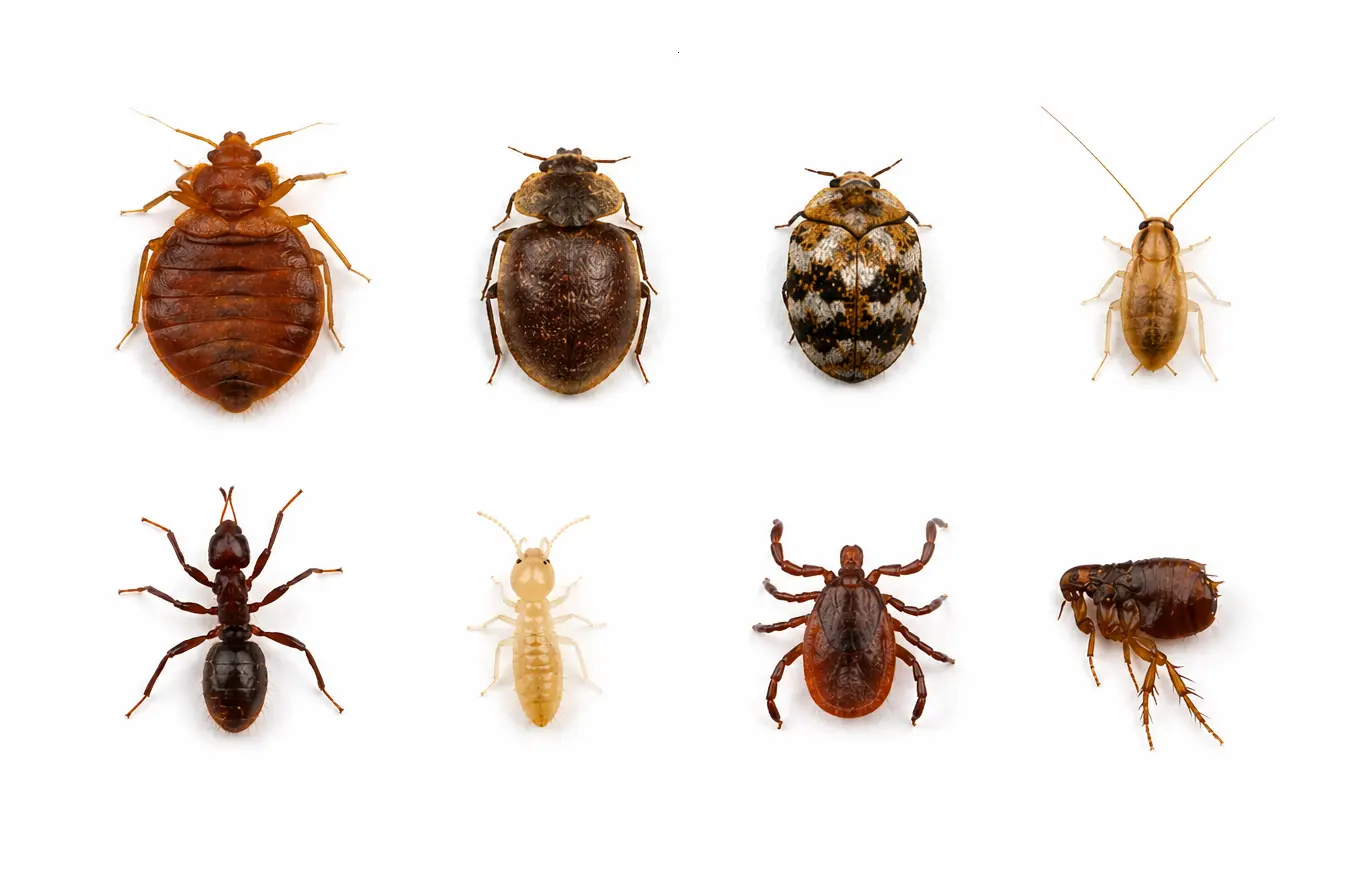
Bat bugs are the look alike that fools experts. They're in the same family as bed bugs, the family Cimicidae, which contains about 75 species worldwide. All of them are obligate blood feeders and all of them look broadly similar.3 Bat bugs and bed bugs are similar enough that even pest control technicians sometimes can't tell them apart without a hand lens or a microscope.
The most reliable visible difference is the length of the fringe of hairs on the pronotum, the shield like plate just behind the head. On a bed bug, those hairs are shorter than the width of the eye. On a bat bug, they're longer than the width of the eye. Under magnification, a bat bug looks like a fuzzy bed bug.4 Without magnification, the two are essentially indistinguishable.
The behavioral clue is much more useful for the average homeowner. Bed bugs live within a few feet of where someone sleeps, in mattress seams, headboards, and bed frames. Bat bugs live near roosting bats, which means attics, chimneys, soffits, and the upper parts of wall voids. If you're finding small brown bugs near a ceiling, around an attic access, in a chimney, or on an upper floor of a building you suspect has bats, the odds tilt heavily toward bat bugs.4
The reason this distinction matters is that the two infestations are solved differently. A bed bug infestation is solved by treating the human living areas. A bat bug infestation is solved by safely excluding the bats and then treating the secondary harborage. Treat one as if it's the other and the problem persists.
The Bird Relative: Swallow Bugs
The other Cimicidae relative that ends up indoors in our part of the country is the swallow bug, Oeciacus vicarius. Swallow bugs feed on cliff and barn swallows, which build mud nests on cliffs, bridges, and the sides of buildings. Oklahoma has plenty of both species of swallow, especially around bridges along the Arkansas River, so a homeowner with swallow nests under a porch eave or an attic vent is a real candidate for a swallow bug encounter.4
Swallow bugs are slightly smaller than bed bugs and are covered in finer, longer hairs over the entire body. They look, in essence, like a bed bug with a faint fuzz coat. Like bat bugs, they require magnification for confident identification. The behavioral clue is the same as with bat bugs. If the small brown bugs are showing up in rooms close to a known nest site, or near a window where birds are nesting, swallow bugs become much more plausible than bed bugs.4
The good news is that swallow bug infestations indoors tend to be self limiting. Swallow bugs cannot reproduce on human blood. They can bite people when their primary hosts migrate or are excluded, but the population can't sustain itself the way a true bed bug colony can. Resolve the bird issue, and the bug issue resolves with it.
The Most Common Confusion: Carpet Beetles
If we had to pick the single insect responsible for the most "is this a bed bug?" calls, it would be the carpet beetle. Carpet beetles, in the family Dermestidae, are everywhere in American homes. A 2016 survey of 50 houses by entomologists at the North Carolina Museum of Natural Sciences found carpet beetles in essentially every home they looked at, regardless of cleanliness or location. They are arguably the most common indoor insect in North America.
The confusion comes from two directions. The adult beetles are small, oval, and reddish brown to mottled, which lines up with a quick glance at a bed bug. And the larvae produce skin reactions that look an awful lot like bed bug bites.
Adult carpet beetles, on close inspection, are nothing like bed bugs. They have a hard shell over the back, the classic dome shape of a tiny ladybug. They have functional wings under that shell and can fly. The Anthrenus species, the most common one in homes, has a mottled pattern of white, yellow, and brown scales that no bed bug has. The shape, even from above, is rounder and more compact than a bed bug's flat seed shape. If you see something flying near a window, it's not a bed bug.
The larvae are where things get interesting. Carpet beetle larvae are small, elongated, carrot or teardrop shaped, and covered in dense reddish brown bristles, like miniature woolly caterpillars. They grow up to about 4 or 5 mm. They feed on natural animal fibers, which means wool rugs, cashmere, silk, fur, taxidermy mounts, dead insects in light fixtures, lint behind dressers, and pet hair that accumulates in undisturbed corners.
The skin reaction is the part that confuses people most. Carpet beetle larvae do not bite. But certain species, most notably Anthrenus, are covered in spear shaped detachable hairs called hastisetae. These hairs detach into the surrounding environment, become airborne in dust or HVAC air streams, and can cause an allergic dermatitis when they catch on skin or mucous membranes.5 The result is itchy red papules that appear in clusters, typically in areas where clothing rubs the skin or where someone has been lying down. A 2021 case series in the CDC's Emerging Infectious Diseases documented seven families in southern France whose members showed exactly this pattern, with the worst affected case being a child whose bedroom was downwind of an air conditioning vent that had become contaminated with larval hairs.6
The pattern is what gives it away. Bed bug bites tend to fall on skin that was directly exposed during sleep. Carpet beetle dermatitis often appears under clothing, in patches matching where lint or dust collected against the skin, and is more diffuse. There are no dark fecal spots on bedding, no shed bed bug exoskeletons, no actual bed bugs found on inspection. Treatment is also completely different. A carpet beetle problem is solved by vacuuming, laundering, and removing the food source. Heat treatment for bed bugs would not address it.
Baby Cockroaches
A newly hatched German cockroach is reddish brown, oval, wingless, and roughly the size of a bed bug. From above, in poor light, it can look like one. This is one of the more common true look alike scenarios, especially in apartments or rentals where both species could plausibly be present.
The differences become obvious as soon as you look closely. Cockroach nymphs are more cylindrical than flat. Their body is shaped like a tiny grain of rice rather than the broad, flat seed of a bed bug. They have long, threadlike antennae, often nearly as long as the body itself, that wave actively as the insect moves. A bed bug's antennae are short and stubby by comparison and stay relatively still. Cockroach legs are noticeably long and spiny. Bed bug legs are short, smooth, and proportional to the body.
Behavior is the easiest tell of all. Cockroach nymphs are fast. When you disturb them, they dart. They scuttle for the nearest dark crack at speeds bed bugs are physically incapable of. Bed bugs walk with a slow, purposeful crawl that almost looks like they don't notice they've been seen. If the bug you're looking at sprinted across the floor, you don't have a bed bug.
Location is another strong signal. Cockroaches want food, water, and warmth, which means they concentrate around kitchens, bathrooms, sinks, dishwashers, and any place crumbs or grease accumulate. Bed bugs concentrate around sleeping areas. A reddish brown nymph found behind a refrigerator is a cockroach. A reddish brown nymph found tucked in a mattress seam is a bed bug.
Right after a molt, cockroach nymphs go through a brief white or pale phase before their new exoskeleton hardens. Some homeowners see these "ghost roaches" and panic about a totally new species. They're just freshly molted babies of the cockroaches they already had.
Spider Beetles
Spider beetles are small reddish brown beetles that, viewed from directly above, can pass for a bed bug. They earn their name from their long legs and large rounded abdomen, which give them a tiny spider like silhouette when you look at them from the side. From above, the shape is similar enough to a bed bug to set off the alarm. From the side, the difference is unmistakable. Bed bugs are flat. Spider beetles are humpbacked, with a swollen rounded abdomen that gives them the look of an apple seed pulled into a sphere.
The American spider beetle, Mezium americanum, is the species most commonly mistaken for a bed bug because it's the most common one in homes. It's about 1.5 to 3.5 mm long, dark reddish brown to almost black, with a shiny globular abdomen and pale yellow head and legs. The whitemarked spider beetle, Ptinus fur, is a touch larger and has white patches on its wing covers.
Spider beetles are scavengers, not blood feeders. They eat almost anything dry and organic. Grain, cereals, dried fruit, pet food, bird seed, dead insects, animal droppings in attics, even the lining of old books and museum specimens. They don't bite, don't transmit disease, and don't have any reason to be anywhere near a human host. If you're finding small brown bugs in a pantry, in an old box of cereal, or near rodent droppings in an attic or wall void, spider beetles are far more plausible than bed bugs.
The treatment, like with carpet beetles, is sanitation rather than insecticide or heat. Find and discard the infested food source, vacuum the area, store dry goods in sealed containers, and the population usually collapses within a few weeks.
Booklice
Booklice are tiny pale insects most commonly mistaken for newly hatched bed bug nymphs. The name is misleading. They're not actual lice, they don't feed on blood, and they're not closely related to either lice or bed bugs. They feed on microscopic mold, fungi, and starchy debris, and they thrive in humid areas with poor airflow.
The visual difference, on close inspection, is straightforward. Booklice are translucent to pale gray or tan, soft bodied, and roughly hourglass shaped, with a clear constriction between the head and the abdomen. Bed bug nymphs, even very young ones, hold the flat oval shape of an adult and become reddish brown after their first feeding. Booklice are also smaller than even the first instar bed bug nymph, often around 1 to 2 mm.
Behaviorally, booklice are usually found in places that have nothing to do with sleeping. Around damp window sills, behind bathroom tile, in basements, on the spines of old books, on the back of damp wallpaper, in rarely used cardboard boxes. Reduce the humidity and remove the mold or mildew they're feeding on, and the booklice population collapses on its own. They don't bite, don't sting, and aren't a health risk in the usual sense, though some research suggests their fragments may contribute to indoor allergen load in heavily infested spaces.
The most useful single test for booklice versus bed bug nymph is color. If a tiny pale insect on a humid bathroom window sill looks almost translucent, doesn't change shape after the room has been occupied overnight, and never seems to be near a sleeping area, booklice are far more likely.
Ticks
An unfed adult tick, especially the brown dog tick, can be a fair visual stand in for a bed bug at a glance. Reddish brown, oval, and roughly bed bug sized. The defining difference, though, is leg count. Ticks are arachnids, not insects. Adult ticks have eight legs. Bed bugs have six. Counting legs is the single fastest, most reliable way to separate the two.
The other clue is shape. Ticks have a hard plate on their back called the scutum, which often carries distinctive markings. Bed bugs have no scutum, no markings, and a uniform shield like body. A tick that has fed will be visibly engorged and balloon shaped, while a fed bed bug elongates rather than ballooning.
Behavior is also unlike a bed bug at all. Ticks attach to a host and stay attached for hours or days while they feed. Bed bugs land on a host, feed for a few minutes, and then crawl off to digest. If you find what looks like a small brown bug embedded in your skin, you have a tick, not a bed bug. Bed bugs never embed.
Across most of Oklahoma, the ticks that get into homes most often are the brown dog tick (which can complete its lifecycle indoors when dogs are present) and seed tick larvae brought in on people or pets after time outdoors. Neither lives in mattresses or bed frames the way bed bugs do.
Fleas
Fleas don't actually look much like bed bugs once you have a clear view of one. They're laterally compressed, meaning narrow when you look at them from above and tall when you look at them from the side, the opposite of a bed bug's top to bottom flatness. They're darker, often a glossy chestnut to nearly black, and notably smaller than an adult bed bug.
The dead giveaway is the jump. Fleas have powerful spring loaded back legs and can leap astonishing distances. A startled flea will be airborne within a fraction of a second of being spotted. A bed bug, faced with the same disturbance, will simply walk away. If the bug you're trying to identify suddenly disappears with a hop, you don't have bed bugs. You have fleas.
The contextual clues differ too. Fleas almost always trace back to a pet, and the easiest place to find them is on the animal, in the animal's bedding, or in carpets where the animal spends time. Bed bugs almost always trace back to a sleeping area, and the most productive places to look for them are mattress seams, headboards, box springs, and the joints of bed frames.
Quick Side By Side Comparison
If you've found a single bug and want a quick sanity check, this table covers the practical differences.
| Insect | Size | Shape | Wings or jump | Bites? | Where found |
|---|---|---|---|---|---|
| Bed bug | 5 to 7 mm | Flat, oval, like an apple seed | Neither | Yes | Mattress seams, headboards, bed frames |
| Bat bug | 4 to 5 mm | Same as bed bug, fuzzier | Neither | Yes, when bats absent | Attics, chimneys, near bat roosts |
| Swallow bug | Slightly under 5 mm | Slightly smaller, finely hairy | Neither | Yes, opportunistically | Near swallow nests on buildings |
| Carpet beetle (adult) | 2 to 4 mm | Round, dome shaped, mottled | Wings, can fly | No | Window sills, wool, light fixtures |
| Carpet beetle (larva) | Up to 4 to 5 mm | Carrot shaped, very hairy | No (immobile in long bursts) | No bite, but rash from hairs | Wool rugs, lint, vents |
| Cockroach nymph | 3 mm and up | Cylindrical, long legs, long antennae | No wings yet, runs fast | Very rarely | Kitchens, bathrooms, behind appliances |
| Spider beetle | 1.5 to 4 mm | Humpbacked, globular abdomen | Has wings, rarely flies | No | Pantries, attics, near droppings |
| Booklouse | 1 to 2 mm | Pale, soft, hourglass shape | Some have wings, doesn't jump | No | Damp window sills, books, basements |
| Tick | 1 to 10+ mm | Round body, hard scutum on back | Neither | Yes, attaches and embeds | Outdoors, on pets, occasionally indoors |
| Flea | 1.5 to 3 mm | Tall and narrow, dark glossy | Powerful jumper | Yes | On pets, in pet bedding, in carpet |
If the first column doesn't match what's in front of you, the rest of the row will usually settle the question.
Telling the Bites Apart
Bites are even harder to identify than the insects themselves, partly because individual reactions vary so much. Roughly 30 percent of people who are actively being bitten by bed bugs show no skin reaction at all, and a small 2009 study found that bed bug bite naive subjects often required repeated controlled exposures before any reaction developed.7 Beyond that, bed bug bites can take anywhere from a few hours to two weeks to appear after the actual bite.8 So the absence of a reaction does not rule out an infestation, and the presence of a reaction doesn't necessarily come from the bug you'd assume.
That said, there are useful patterns. Here's what tends to distinguish the common biting culprits.
Bed bug bites
WhereUpper body, especially face, neck, arms, hands, and shoulders. Skin that was uncovered or pressed against bedding while asleep.
PatternSmall clusters or short straight lines of three to five bumps. Sometimes called the "breakfast, lunch, dinner" pattern when one bug feeds in a row.
TimingNo sensation when the bite happens. Itching can be delayed by hours to days, sometimes longer in first time exposure.
LookRed raised welts, sometimes with a darker dot in the center. Often resemble mosquito bites except for the clustering.
Flea bites
WhereLower body, especially ankles, lower legs, behind knees. Around the waistline if pets sleep on furniture or bedding.
PatternScattered random clusters of small red dots, often grouped in twos and threes but without the linear feeding row of a bed bug.
TimingItches almost immediately. The bite is felt as a small sharp pinch.
LookSmall red bumps, often with a darker pinpoint puncture in the center, surrounded by a halo of irritated skin.
Chigger bites
WhereAnywhere clothing fits tightly: waistband, sock line, bra line, behind the knees. Below the beltline most often.
PatternMany small bites concentrated in bands where elastic or fabric pressed the skin. Onset 6 to 12 hours after time outdoors.
TimingIntense itching that often gets worse at night, can persist a week or two.
LookSmall red bumps that look almost like pimples, often with a tiny central red spot.
Mosquito bites
WhereAny exposed skin. Often face, ears, scalp, ankles, arms.
PatternIsolated bites, not clustered or linear. Usually only a few at a time.
TimingReaction within minutes. Itch peaks within an hour or two.
LookSoft, round, puffy welts. Tends to be larger and softer than bed bug or flea bites.
Two clinical points worth keeping in mind. First, you cannot diagnose an infestation from bites alone. Even the clearest bite pattern in the world is consistent with several different sources, and individual sensitivity varies enormously. A 2012 review in Clinical Microbiology Reviews emphasized that bites should be considered suggestive, not diagnostic, and that confirmation requires finding the actual insect or its physical signs (fecal spotting, shed skins, or live specimens).8
Second, the carpet beetle dermatitis we mentioned earlier deserves an honorable mention here. The papules from larval hairs can look strikingly like bed bug bites, and they tend to appear in clusters where dust or lint settled against the skin. They show up under clothing, not on exposed sleeping skin, and they don't come with any of the secondary signs of a bed bug infestation. If the bites are showing up on the inside of pant legs or the small of the back, with no apple seed sized bugs anywhere near the bed, carpet beetles are worth considering.5
The Field Test: What to Do When You Find a Suspicious Bug
If you've found a bug you can't identify, the most useful thing you can do is preserve it and get a clear look. Here's a field protocol that works.
First, don't crush it. A flattened insect is much harder to identify than an intact one. Use a piece of clear tape to lift it onto a sheet of white paper, or scoop it into a small jar or zip bag. The clear tape method is best because it preserves shape and color while flattening the bug enough to photograph.
Second, take a sharp, well lit photo. A phone camera in macro mode, against a plain light background, with strong overhead light, will capture enough detail for a professional to identify the species. Shoot from directly above and from the side. The side view is especially important for telling spider beetles, fleas, and bed bugs apart, because the side profile is where the differences are most obvious.
Third, look for the corroborating evidence. Bed bugs almost never appear in isolation. By the time you find one walking around in daylight, there are usually more, and there are signs. Look for small dark fecal spots on bedding (they smear like ink when wiped with a damp cloth), pale shed exoskeletons in mattress seams, and clusters of pinhead sized white eggs glued to fabric or wood. The absence of those signs is meaningful. A single suspicious bug found near a window with no other evidence anywhere near the bed is almost never the start of a bed bug infestation.
Fourth, when in doubt, get a professional eye on it. Most pest control companies, including ours, will identify a sample at no charge. A clear photo, or a captured specimen in a sealed bag, is enough for an experienced technician to make the call quickly. The cost of being wrong, in either direction, is much higher than the cost of asking.
Why Misidentification Is Expensive
The reason it's worth being careful here is that the four most likely treatment paths for the bugs above are completely different, and applying the wrong one wastes money in different ways.
Bed bugs require either a thorough heat treatment or a multi visit chemical protocol that targets every life stage including eggs. Heat kills all stages in a single visit. For more on that, see our piece on comparing bed bug control methods.
Bat bugs and swallow bugs require excluding the wild animal host first. Treating only the visible bugs without removing the bats or birds simply lets the population reestablish.
Carpet beetles are sanitation and source removal problems. Vacuum thoroughly, identify the natural fiber food source (wool rugs, taxidermy, accumulated lint, dead insects in light fixtures), and the population starves.
Cockroaches are baited, not heat treated. They live in different places, eat different things, and respond to different products. Treating a cockroach infestation as if it were bed bugs misses everywhere they actually live.
Spider beetles, booklice, and pantry pests are food source problems. Find and discard the contaminated grain, dried fruit, pet food, or moldy paper, and they're gone in a few weeks without any chemical treatment.
Fleas require treating the pet, treating the carpet, and breaking the lifecycle in pet bedding. None of that is what you'd do for bed bugs.
Ticks are an outdoor and on pet problem most of the time, with rare indoor establishment by the brown dog tick. Bed bug treatments don't address them.
Treating a non bed bug as a bed bug means you spend money that didn't need to be spent and potentially miss the real problem. Treating a bed bug as a non bed bug means the population grows during the wait. Either way, accurate identification at the start saves time, money, and a lot of frustration.
Common Questions
Often yes, if the photo is sharp enough to show the body shape, the antennae, and the legs. Bat bugs and swallow bugs are the only common look alikes that genuinely require magnification to distinguish, because they're in the same insect family as bed bugs. The other look alikes (carpet beetles, cockroach nymphs, spider beetles, fleas, booklice, ticks) all have visible features that show up in a decent photograph.
Not necessarily, but it's worth investigating other causes before assuming bed bugs. Skin reactions can come from carpet beetle larval hairs, dry skin and dust mites, contact allergens in laundry detergent or fabric softener, scabies, or even stress related itching. A real bed bug infestation almost always leaves physical evidence (fecal spotting, shed skins, live or dead bugs in mattress seams) within a few weeks of biting starting. If you've inspected carefully and found no signs, the bites are most likely from something else.
No. The "breakfast, lunch, dinner" pattern of three bites in a line is real but not universal. Bed bug bites often appear as scattered clusters, single welts, or in no particular pattern at all, depending on how many bugs fed and whether the host moved during feeding. The presence of a linear pattern is suggestive of bed bugs. The absence doesn't rule them out.
Surprisingly, no. Spider beetles, carpet beetle larvae, booklice, fleas, and even ticks can all end up on or near a bed without it being a bed bug situation. The location is suggestive but not definitive. The shape of the body, the legs, the antennae, and the presence of corroborating evidence (fecal spots, shed skins) is what makes the call.
Look at the antennae and the body shape. Bed bug nymphs have short stubby four segment antennae and a flat oval body. Cockroach nymphs have very long thin antennae, often as long as the body, and a more cylindrical shape. Cockroach nymphs also dart fast when disturbed, while bed bugs walk slowly. The locations are usually different too. Cockroach nymphs are near food and water (kitchens, bathrooms), while bed bug nymphs are near sleeping areas.
Adult fleas prefer to stay on a furry host and don't normally live in bedding without a pet sleeping there. If your dog or cat sleeps with you, fleas can definitely bite you in bed, but the source is the animal, not the mattress. If there's no pet in the home and the bites are happening at night, fleas are unlikely to be the cause.
Not entirely. The bugs themselves are killed the same way (heat or insecticide), but unless the bat colony causing the infestation is excluded first, new bat bugs will keep appearing. Bat exclusion is a specialty job, often involving local wildlife rules because some bat species are protected. The treatment sequence is exclude the bats, then treat the residual bug population. Skipping the first step is why bat bug infestations sometimes seem to "come back" after treatment.
Bed bug bite reactions can be delayed by days or weeks, especially in people who've never been bitten before. Repeated exposures speed up the reaction over time, but a first time hotel encounter can produce welts that show up well after you've returned home, leaving you to wonder where they came from. That's also a useful reason to inspect luggage carefully, since the bugs that bit you may have come home with you. We cover that in detail in our guide to avoiding bed bugs while traveling.
The Bottom Line
Bed bugs have a few very specific features. Flat oval body, six legs, short stubby antennae, no wings, no jumping, slow crawl, and a habitat tied tightly to where humans sleep. Almost everything else can be ruled out on at least one of those traits.
The eight or so insects most often confused with bed bugs each break the pattern in their own way. Bat bugs and swallow bugs look almost identical but live near bats and birds rather than people. Carpet beetles are rounder and have a hard wing shell, and their larvae cause skin reactions that mimic bites without any actual bug being present in the bed. Cockroach nymphs are cylindrical, fast, and have long antennae. Spider beetles are humpbacked. Booklice are pale and soft and live in damp places. Ticks have eight legs and embed when they feed. Fleas are tall and narrow and jump.
If you've found a bug, photograph it, preserve it, and look for the corroborating evidence around the bed before assuming the worst. If you've got bites but no other signs, consider whether something other than bed bugs could be responsible. And if you're unsure, ask. We'd rather identify a sample for free and tell you it's a carpet beetle than have you go through a treatment you didn't need, or skip one you did.
Either way, the goal is the same as it is with any pest problem. Know what you're actually dealing with, then handle it directly.
References
- U.S. Environmental Protection Agency. (n.d.). Bed Bugs Appearance and Life Cycle. EPA Bed Bug Resource. epa.gov/bedbugs.
- Reinhardt, K., & Siva-Jothy, M. T. (2007). Biology of the bed bugs (Cimicidae). Annual Review of Entomology, 52, 351-374.
- Usinger, R. L. (1966). Monograph of Cimicidae (Hemiptera-Heteroptera). Thomas Say Foundation, Entomological Society of America.
- Cranshaw, W., & Camper, M. (2022). Bed Bug Lookalikes: Bat Bugs and Swallow Bugs in Colorado. Colorado State University Extension Fact Sheet 5.625.
- Johnson, A. G., Hoverson, K. M., & Elston, D. M. (2024). What's Eating You? Carpet Beetles (Dermestidae). Cutis, 113(3), E6-E9.
- Simon, L., Boukari, F., Oumarou, H., Delaunay, P., Picot-Guéraud, R., & Lacour, J. P. (2021). Anthrenus sp. and an uncommon cluster of dermatitis. Emerging Infectious Diseases, 27(7), 1940-1942.
- Reinhardt, K., Kempke, D., Naylor, R. A., & Siva-Jothy, M. T. (2009). Sensitivity to bites by the bedbug, Cimex lectularius. Medical and Veterinary Entomology, 23(2), 163-166.
- Doggett, S. L., Dwyer, D. E., Peñas, P. F., & Russell, R. C. (2012). Bed bugs: Clinical relevance and control options. Clinical Microbiology Reviews, 25(1), 164-192.